Wednesday, July 22, 2009

Day Twenty-Four

Monday July 20

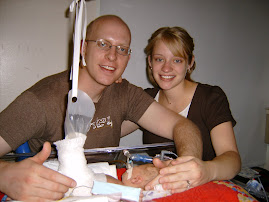
It was just Grandma and I today. As you can see, he was fairly awake for us and we were even able to catch those eyes on camera. We were surprised when we first got to the bedside because it was the first time he had ever been wearing clothes! Sure it was just a little striped onesie and some blue socks, but we just couldn't get over how cute it was.

Things are finally looking up. His belly measurements are coming down. Apparently he did have a bowel movement yesterday. Is it strange that I was a little upset that they didn't call me about that? They have also turned his oxygen down to 21% which is the same as room air. The cannula is on a very low flow setting. With this minimal help his oxygen saturation is still just peachy, so it looks like those red blood cells are back in business. I am hoping to see that cannula come off again soon.

Right before my mom and I left, surgery came and did their rounds. They informed us that Will's Anderson tube was looking so good that they would try to get it off in the next day or two. I am so excited to see these tubes go away!
Posted by Picasa

No comments:

Post a Comment

About Gastroschisis

I have posted some links for your information and research, but here's the run down on gastroschisis.

What is it?
Gastroschisis is a birth anomaly in which the baby's abdominal wall does not close all the way during early development. These abdominal defects can result in several problems, the least of which is gastroschisis. This is when some of the intestines escape through the small opening in the abdomen and are now outside the baby's body. During pregnancy these organs are exposed to the amniotic fluid for some time which makes the once maliable and functional bowel stiff and swolen.

How is it treated?
Since gastroschisis is not as serious as other similar defects, it is not dangerous to still deliver the baby vaginally. Upon delivery the baby will go to the NICU and be examined by the pediatric surgeons. At this point of evaluation, there are several courses of action. What needs to happen eventually is that the bowel needs to be surgically put back into the abdomen of the baby.

Option 1: If the bowel has little damage, is quite maliable and healthy, and the baby's belly seems to have the room to accept all of the intestine at once, the surgeons will perform a "primary closure". The surgery is fairly simple. They will make an incision to enlarge the opening enough to push the bowel back inside and sew it up once it is finished.

Option 2:
If the bowel is stiff and swolen and or the baby's belly does not have the room to accept it all at once, they will perform a "staged closure". This is more complicated and takes some time. This invloves placing a "silo" over the bowel (this is basically a bag that holds the bowel suspended above the opening). This silo will be somewhat inserted into the baby's belly so as to allow the abdominal fluids to enter and thus healing the bowel by bringing the swelling down and making it malleable again. As the bowel heals and with a little assistance from the doctors the bowel will slowly but surely re-enter the baby's abdomen.

Recovery
A staged closure can take up to a week or two. So you may ask why does he have to be in the hospital for 5 to 6 weeks. Since the baby's system is not used to the pressure introduced by this bowel that is now inside the abdomen, and the bowel has been exposed to the amniotic fluid for so long, it simply takes time for the baby's digestive system to normalize. Aside from the digestive system, other things may be affected such as breathing due to the increased pressure inside the body. The baby's recovery can be broken down into three distinct stages. Pre-Surgery, Post-Surgery/Pre-Feedings, and Post-Feedings.

The first is simply the waiting period before the baby's bowel can be put back inside.

The next period is after surgery, the baby's system is still very fragile and can only be fed interveinously. During this time the amount of nutrients is slowly increased until the baby is ready for the final stage, when his body can accept real food.

Once on breast milk feedings from a bottle, the baby is closely monitored. The process is slow as the baby must phase into these feedings from the IV. Once the baby is up to full feedings and is gaining weight, we can all go home!

Long term effects
Once the baby has fully recovered and is ready to go home, he should be fit as a fiddle and have little or no related complications thereafter. The main thing that he may experience is a case of acid reflux, but this can be treated with medication and it usually will go away as he grows and gets older.