 Blaise and I dropped my mom off at the airport early this morning. It has been so nice having her here. I so needed her help physically and emotionally. I miss her already.
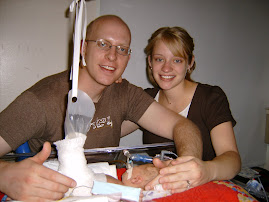
We headed over to the hospital right away. We hoped that we would be there for rounds and possibly for his first feeding. When we arrived at the bedside we were thrilled to see that the nurse was the same one that was with Blaise and Will on day one. He was sound asleep and so peaceful. She had him wrapped up really tight and told us that she had sung to him a little bit and that it really calmed him down. His warmer on the bed was turned off just to see if he could handle it on his own. I had never seen his heart rate so normal, not since before he was born at our non-stress tests had he been down in the 150's. His entire hospital stay it has been normal for him to be in the 160's and 170's. We wonder if maybe he is just more content to be on the cooler side, or maybe he just really liked being sung to. Also, the swelling in his belly is almost completely gone.
 We were there for rounds and they did give the go ahead to start feedings today. He will get 4cc's every three hours. That's less than a tablespoon for each feeding. His first feeding was at 2pm and by then we had a new nurse for the afternoon. She was really great. She performed the actual feeding (good thing, because it was quite the juggling act) but she was really good about walking us through it and letting us be as involved as possible. The thing was that since 4 cc's is such a small amount, they just put the milk in a syringe and squirt it into the nipple of a bottle. We had quite the time trying to wake him up. He was half asleep during the feeding itself. He kind of choked and spat at first, but once he figured out the sucking-breathing-swallowing thing he guzzled it all. We had so much fun watching him try out this new thing.
Wednesdays at 12:30 they have something called Parent Hour. We got free lunch while we listened to a presentation about baby stress signs and soothing techniques. It was really informative and interesting. There were at least a dozen other couples and parents there. We all went around the table and shared our brief stories. It amazed us to hear about other babies that had so many complications or worse conditions than ours. We all mingled afterwards and Blaise & I met a few parents that we had some good conversations with. It was really neat to connect with other parents that are living the NICU life too. There was also a whole table full of donated items like blankets, hats, teddy bears, binky's, and other baby stuff that was up for grabs. It was a really nice break and such a humbling experience.






What a cutie!
ReplyDeleteHooray for Will! (and I have to say again - HE IS SO STINKIN' CUTE!)
ReplyDeleteI am so happy for you guys!! He is so cute! It's fun to see him without all the tubes, and it will be even funner when you guys are able to take him home. I'm so glad that you have been blessed through this experience. I'm so glad for all of you!
ReplyDelete