 This morning as Blaise was getting ready to go to his part time job he stopped and suggested that we go up to Salt Lake now and he could just go in to work for the afternoon.
On our way to the see Will, I got a funny phone call from University Hospital. They said that they thought they had me scheduled for an induction the night before and was wondering why we didn't show. I told them we wouldn't be needing that. : )
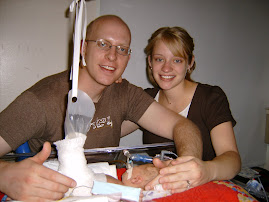
When we got to the NICU and approached Will's bed there were two respiratory specialists there. The nurse happily informed us that we had arrived just in time for them to take him off of the ventilator (remove his breathing tube). Apparently Will had responded so well to the weaning they had been doing since his surgery that they decided to let him try breathing all on his own. We couldn't believe it! They took the breathing tube out and just gave him a cannula for his nose to help him out with a little oxygen (just 30%). So we were there to watch him struggle taking his first breaths flying solo. He did so well. The nurse said that they planned to watch him very closely. She said they would keep him off the ventilator if he could "prove himself". That meant having a respiratory rate between 30-60 and not being too stressed or strained. We sat at the bedside for a little over an hour and he passed with flying colors. We cheered him on as he got the hang of the breathing thing.
 Along with taking him off of the ventilator they needed to take him off the sedation so that he can be more aware of trying to breath on his own. With that we are hoping he will be more awake for us in the coming days. Maybe we'll get to see what color his eyes are soon. They also decided to scale down his pain medication. Up until now he has been on a constant flow fentanyl which the nurse said was many times stronger than morphine. Now they have him on scheduled doses of morphine for pain.
Will reached yet another milestone or two today. They removed the cathiter; just one more thing that he gets to do on his own now. Also, he has had a direct line into an artery in his arm (that's is why he has a splint on his left arm) that they have used to draw blood regularly for blood gas tests. Well, those blood tests have been coming back with such normal levels that they decided to remove that as well.
 He is just shedding these needles and tubes left and right! The nurses seem confident that we will get to hold him tomorrow. We are hopeful that this is the case and we've made plans to go up first thing tomorrow morning. We can hardly wait.





That is awesome to hear that he is doing so well, and that would be great if you got to hold him tomorrow. Hope all goes well in the the coming weeks, and that he will continue to shed those needles.
ReplyDeleteThat's so exciting! I'm glad to hear that he's doing so well. I hope you get to hold him tomorrow, that will be a sweet moment. We will continue to pray for all of you.
ReplyDeleteI have loved seeing your updates every day. I am totally cheering Will on and couldn't be happier that he is doing so well. He's lucky to have a mom and dad who are so involved and on top of his situation. Keep up the good (
ReplyDeleteand strong) work! My fingers are crossed that you get to hold him tomorrow--you'll be in our prayers tonight!
You are in our prayers and we hope all is well! He is very cute! Let us know if you need anything!
ReplyDelete